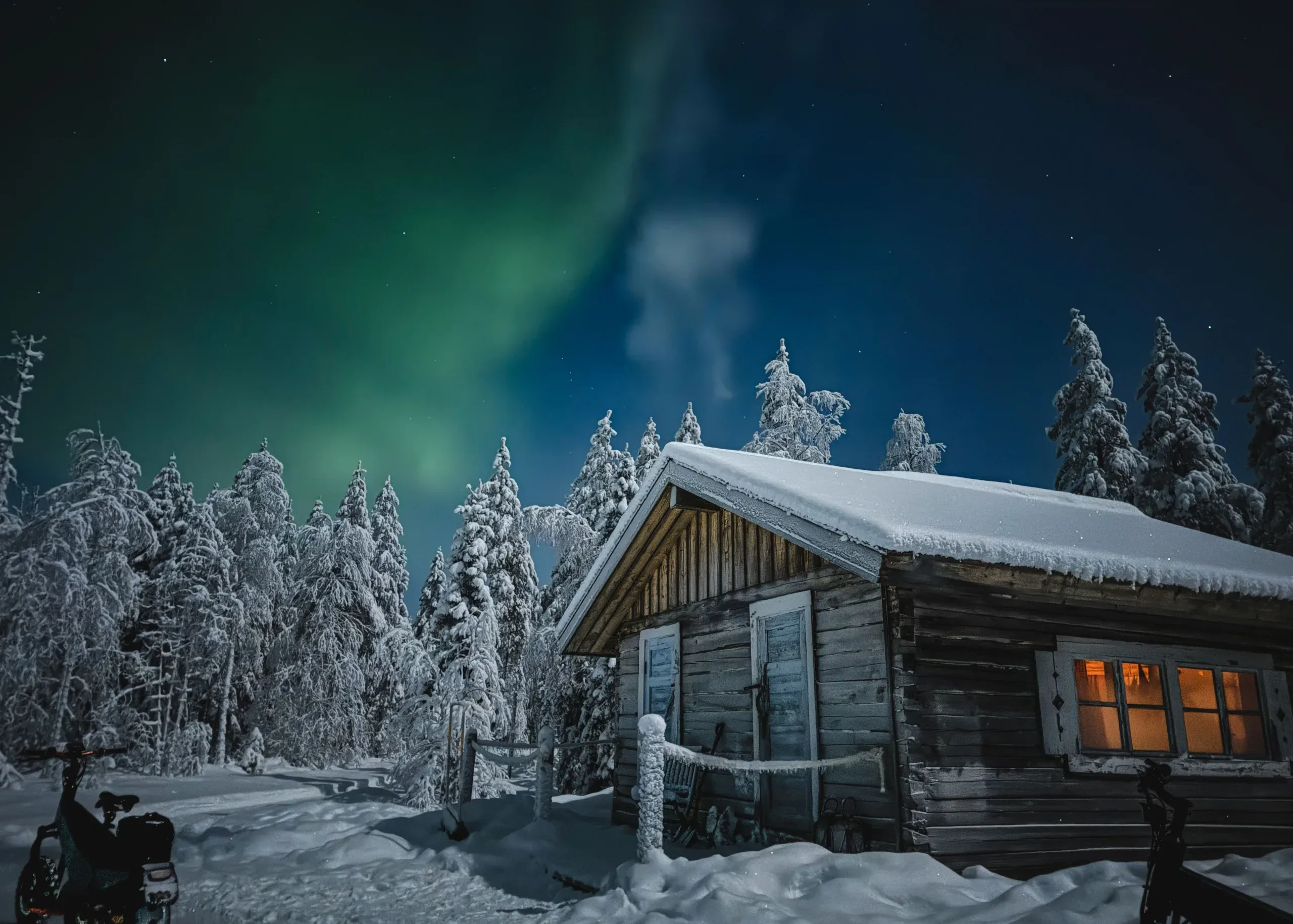
Northern lights in Rovaniemi
The short answer
Cloud decides your aurora night in Rovaniemi, not solar activity, and that single fact should drive every choice you make. A tour cannot summon the lights; what it sells is a driver who has watched the cloud maps all day and will move you to a gap in them, plus warmth and photographs. On a clear night with any way of getting twenty minutes out of the centre, you can do this yourself for nothing. On a patchy night, the tour is the only real chance you have.
How the operators compare
Prices are the operators' own published starting prices as of the date this guide was updated, and they change through the season.
| Snowtrail Safaris | Beyond Arctic | StayLapland | |
|---|---|---|---|
| From | €109 — lowest starting price | €145 | €109 — lowest starting price |
| Duration | 3 h | 5–7 h | 4–5 h |
| Max group | 8 per guide — smallest group | 8 — smallest group | Not stated |
| Min age | 3 years — lowest minimum age | 8 years | Not stated |
| Hotel pickup | Yes — hotel pickup included | Yes — hotel pickup included | Selected points |
| Warm clothing | Not stated | Yes — warm clothing included | No |
-
Snowtrail Safaris
- From
- €109 — lowest starting price
- Duration
- 3 h
- Max group
- 8 per guide — smallest group
- Min age
- 3 years — lowest minimum age
- Hotel pickup
- Yes — hotel pickup included
- Warm clothing
- Not stated
The cheapest of the three and the only one that will take a three-year-old. Three hours is also the shortest hunt here, so an evening where the cloud breaks late is an evening this tour can miss. Two figures here come from the company's site-wide claims rather than the tour page: the eight per guide, and the winter overalls and boots, which the tour page itself does not mention either way. Both are worth confirming when you book.
-
Beyond Arctic
- From
- €145
- Duration
- 5–7 h
- Max group
- 8 — smallest group
- Min age
- 8 years
- Hotel pickup
- Yes — hotel pickup included
- Warm clothing
- Yes — warm clothing included
The long option, and the only one that hands you a thermal suit and boots. Book it if you want photographs of yourselves under the aurora rather than of the aurora alone: a professional photographer comes along and edited images follow a few days later. Children aged 8 to 12 pay €108, and under-eights cannot come at all.
-
StayLapland
- From
- €109 — lowest starting price
- Duration
- 4–5 h
- Max group
- Not stated
- Min age
- Not stated
- Hotel pickup
- Selected points
- Warm clothing
- No
A bus rather than a minibus, at the same price as Snowtrail's van, and the only one of the three that promises your money back if no aurora is captured. Pickup is from four named points rather than from any hotel, neither group size nor minimum age is published, and you bring your own warm clothes.
Highlighted figures are the best in that row: lowest starting price, smallest group, lowest minimum age, hotel pickup included and warm clothing included. Ranges are judged on their lower figure. Duration is not marked — a longer hunt is not automatically a better one.
Where these figures come from
- Snowtrail Safaris snowtrailsafaris.com read 9 Sept 2026
- Beyond Arctic beyondarctic.com read 9 Sept 2026
- StayLapland staylapland.com read 9 Sept 2026
- Snowtrail Safaris: The cheapest of the three and the only one that will take a three-year-old. Three hours is also the shortest hunt here, so an evening where the cloud breaks late is an evening this tour can miss. Two figures here come from the company's site-wide claims rather than the tour page: the eight per guide, and the winter overalls and boots, which the tour page itself does not mention either way. Both are worth confirming when you book.
- Beyond Arctic: The long option, and the only one that hands you a thermal suit and boots. Book it if you want photographs of yourselves under the aurora rather than of the aurora alone: a professional photographer comes along and edited images follow a few days later. Children aged 8 to 12 pay €108, and under-eights cannot come at all.
- StayLapland: A bus rather than a minibus, at the same price as Snowtrail's van, and the only one of the three that promises your money back if no aurora is captured. Pickup is from four named points rather than from any hotel, neither group size nor minimum age is published, and you bring your own warm clothes.
Almost everything written about the aurora in Rovaniemi is written as though seeing it were a matter of booking the right tour. It is not. Two things decide your evening, and an operator controls one of them.
What a tour can change, and what it cannot
It cannot make the sun active. Whether there is an aurora over Lapland tonight was settled a day or two ago, ninety-three million miles away, and every operator in town is working from the same forecast you can read for free.
What a tour changes is where you are standing when it happens. A guide who has watched the cloud maps since morning can drive an hour to a hole in the overcast, and that is most of what separates a good aurora night from a night spent looking at grey. The rest of what you are paying for is real but ordinary: a warm suit, somewhere to sit, hot juice, and someone who knows how to expose a camera for it.
Judge the tours on those things, because they are the things that vary. Do not judge them on their aurora photographs, which are all taken on the good nights.
How often the lights appear this far south
The Finnish Meteorological Institute publishes observation frequencies by region. Kilpisjärvi, in the far north-west, gets the aurora on about three nights out of four. Around Sodankylä it is roughly every other night. On the Oulu–Kuusamo line, about every fourth.
Rovaniemi is not on that list. It sits between the last two, so between every second and every fourth night is as precise as anyone can honestly be. The same series continues south, and the Institute’s figure for the capital is why you can see the northern lights in Helsinki about one night a month — a real answer, and a long way from every other night.
All of those figures count clear nights. Cloud, not the sun, is what ends most aurora nights here, which is why a mild, overcast December week can produce nothing at all while three cold, still nights in February produce three sightings. Book on the cloud forecast rather than the aurora forecast — and if you are choosing which night of your trip to spend on this, that is the number to look at.
It is also why the long tours cost what they do. Five to seven hours is not showmanship. It is the time it takes to drive somewhere else and wait.
Which months to come
The Institute names spring-winter and early autumn as the statistically most favourable periods, because the Earth sits at its most receptive angle to the solar wind around the equinoxes. Its own recommendation is March, which pairs the equinox with the settled, clear weather that late winter brings to Lapland.
Early autumn is a weaker bet this far north than the statistics alone suggest: the aurora is active, but the nights are not yet properly dark. In practice the usable stretch runs from roughly late August, when darkness returns, to mid April, when it goes again — the local operators’ own booking calendars open and close at about those points.
Latitude is the other lever, and a weaker one than most people assume: where else in Finland to see the northern lights ranks the alternatives by how far the dark is from the bed rather than by how far north they are, because on a cloudy night the ranking is worth nothing.
If you can pick your dates freely, take late February or March. If you cannot, come in the darkest months and accept that you are buying more nights to compensate for worse odds on each one. The aurora is not the only thing with a season: winter activities in Rovaniemi, month by month sets out when the husky, reindeer and sleigh seasons open and close against the daylight each month leaves you.
Be outside between about ten and midnight
The Institute puts peak probability near eleven in the evening, close to midnight, when magnetic disturbance is strongest. That is why the tours here leave at eight or nine rather than at six.
Watching on your own, the classic mistake is stepping out at nine, seeing an empty sky and going to bed. Set an alarm, look again at half past eleven, and look north: at this latitude the aurora usually arrives as a pale arc low on the northern horizon rather than overhead.
What you will be standing outside in
Of the three tours compared below, only Beyond Arctic states plainly that a thermal suit and boots come with it. StayLapland says the opposite just as plainly: dress warmly in layers, and they will bring the hot drinks. Snowtrail is the one to ask about. Their homepage promises winter overalls, boots and gloves as a general feature of their tours, but the aurora tour’s own page does not mention clothing at all — so confirm it rather than assume it either way.
This matters more than it does on a daytime activity. January in Rovaniemi averages −10.3 °C, and the nights you actually see the aurora on are the clear ones, which are colder than the average. You will also be standing still for most of it, watching, rather than working a sled.
If nobody is handing you a suit: wool or synthetic next to the skin, never cotton, then a warm mid-layer and a windproof shell. Proper winter boots a size up, with room for thick wool socks. Then the parts people forget, which are the parts that end the evening early — a hat that covers the ears, something over the neck and chin, and mittens rather than gloves. Bring a spare pair, because you will take them off for the camera.
When you do not need a tour at all
If the sky is clear and you have any way of getting fifteen or twenty minutes out of the centre, you do not need to buy anything. Rovaniemi is small and the light pollution stops quickly. A river bank, a frozen lake or any unlit road facing north will do.
Book a tour when the forecast is patchy and you want someone else to solve it, when you want photographs of your family under the lights, or when you have one night and no car. Those are good reasons.
Which tour follows from which reason. With children the question is where a child waits for a sky that may not arrive, and an aurora evening that takes children sorts the tours by whether that wait happens in a cabin, a teepee or a heated sleigh. With a group of your own, what a private northern lights tour changes over a shared one — and what happens to the money on a cloudy night — is worth pricing per head before you assume it is out of reach. And if the driving is half the point, a snowmobile aurora tour splits the evening between the machine and the waiting, which suits some people and ruins it for others. “Because otherwise I will not see them” is not one, and any operator who implies it is selling you the sky.
How many nights you give the sky matters more than which one you buy a tour for, and that is a question about the shape of the whole trip rather than about the aurora — our Rovaniemi planner works it out against the days.
Questions people ask
What happens if the lights do not appear?
It depends entirely on the operator, and it is worth reading before you book rather than after. Of the three compared here, StayLapland is the only one that promises money back if no aurora is captured. Snowtrail Safaris states no guarantee at all and says plainly that nature decides. Beyond Arctic sends professional photographs from the evening whatever the sky did. None of these is wrong, but they are three different products, and the price alone will not tell you which one you are buying.
Can I photograph the aurora with a phone?
A recent phone with a night mode will capture a bright display, and the result will look greener and more defined than what you saw, because a camera sensor collects colour in the dark far better than your eyes do. The practical problem is holding still for a multi-second exposure: rest the phone on a car roof, a fence post or a bag rather than trying to hold it. If you want pictures with people in them, that is harder, and it is what the photographer tours are actually selling. Beyond Arctic and StayLapland both include edited images; Snowtrail lists photography as an extra on request.
Is an aurora tour reasonable with young children?
It depends more on the finish time than on the child. These tours are built around the late-evening peak, so a three-hour trip is out until around midnight and a long one considerably later, most of it spent standing still outdoors in the dark. Beyond Arctic sets its minimum at eight years for that reason. Snowtrail will take a three-year-old, which makes it the only one of the three open to small children, but you should still decide honestly whether yours will last two hours in the cold at eleven at night.